The Gospel of Food by Barry Glassner
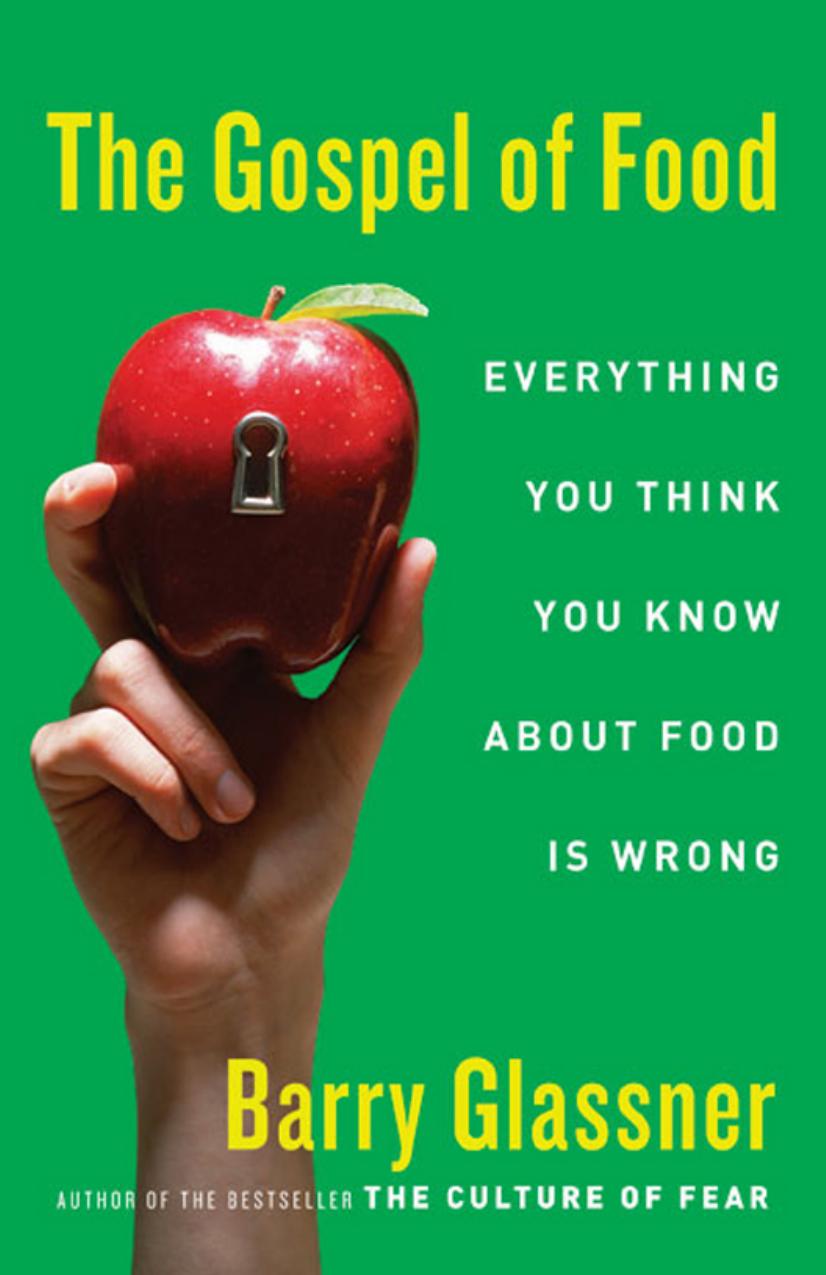
Author:Barry Glassner
Language: eng
Format: mobi, epub, pdf
ISBN: 9780060501211
Publisher: IB Dave's Library
Published: 2007-08-15T07:00:00+00:00
"naked chef," Jamie Oliver.
The Almond Board makes expert use as well of another triedand-true method for positioning a food apart from its similarly hyperbolized competitors. It depicts almonds as great not just in their own right, but for bettering other foods, as a way to make treyf safe. In an ad in a trade magazine for food developers, below the headline, "thank you, science," and above pictures of fruit drinks and cereals topped with almond slices, the Almond Board reveals that "78% of consumers recently agreed that a product containing almonds is better nutritionally. Which means that now, the added value of almonds goes even further than crunch, flavor and
appeal--they can give any
product a healthy halo."14
An Orgy of Evidence
That brings up a question I have addressed at several points in this book: Why not rely on science for advice about what to eat?
Although food marketers and advocacy groups shamelessly hijack science for their own opportunistic ends, this does not mean that scientists cannot say which foods are best. It's hard to deny the wisdom of relying upon nutritional scientists for some kinds of dietary guidance. If you don't want scurvy, you'd better consume some vitamin C. If you're planning to become pregnant, you need enough folic acid to protect your child against neural tube defects. If you're suffering from Conclusion 213
iron-deficiency anemia, you are well advised to eat raisins, beans, liver, eggs, and other foods high in iron.
But deficiency disorders are very different from obesity, heart disease, cancer, and other chronic diseases that Walter Willett and friends say we can thwart by eating their favored foods. Chronic diseases are caused, as we have seen, not by a missing nutrient, but by a complex interplay of genetics, stress, physical inactivity, and a host of other factors. Undoubtedly, diet plays a role, but science is ill-equipped to tell us how much of a role, or which ballyhooed foods are ultimately the most healthful. Depending upon which aspects of its chemical composition one focuses upon, any nutrient-rich food can come off as magical or deficient. Beef is a good example. Viewed one way, it is loaded with essential vitamins, minerals, and protein, a fact that the beef industry presents frequently in ads to consumers and testimony before government nutrition panels. Viewed another way, beef lacks fi ber and has an excess of "bad" fats and calories, as groups like the Physicians Committee for Responsible Medicine routinely point out.
In planning meals to prevent disease, "think broccoli, tomatoes, blueberries, sweet potatoes, and garlic," the PCRM urges, and notwithstanding the body odor and frequent trips to restrooms such a diet would produce, heaps of studies support the ultra-low-fat, high-fi ber view.
But was a spokesman for Atkins Nutritionals off base when he testified at a government hearing on the food pyramid that
"much as the low-fat advocates and the animal rights activists would like to believe otherwise, the accumulating body of scientifi c evidence can no longer be ignored"? He and his colleagues cite an enormity of studies that corroborate their pro-protein, anticarb theory.
Download
The Gospel of Food by Barry Glassner.epub
The Gospel of Food by Barry Glassner.pdf
This site does not store any files on its server. We only index and link to content provided by other sites. Please contact the content providers to delete copyright contents if any and email us, we'll remove relevant links or contents immediately.
Nutrition for Sport, Exercise, and Health by Spano Marie & Kruskall Laura & Thomas D. Travis(3787)
Nutrition for Sport, Exercise, and Health by Marie Spano & Laura Kruskall & D. Travis Thomas(3735)
The Sprouting Book by Ann Wigmore(3593)
Flavor Flours by Alice Medrich(2868)
Superfood Smoothie Bowls: Delicious, Satisfying, Protein-Packed Blends that Boost Energy and Burn Fat by Chace Daniella(2485)
Memory Rescue by Daniel G. Amen(2426)
Dirty Genes by Ben Lynch(2318)
The Bad Food Bible by Aaron Carroll(2275)
Genius Foods by Max Lugavere(2222)
The Poisoner's Handbook by Deborah Blum(2143)
Good Calories, Bad Calories by Gary Taubes(2113)
The Main Street Vegan Academy Cookbook by Victoria Moran(2089)
The I Quit Sugar Cookbook by Sarah Wilson(2044)
Core Performance Essentials by Mark Verstegen(2015)
Memory Rescue: Supercharge Your Brain, Reverse Memory Loss, and Remember What Matters Most by Amen Dr. Daniel G(1981)
Big Girls Do It Stronger by Jasinda Wilder(1964)
Android App Development by Franceschi Hervé J.;(1845)
Sugar Crush by Dr. Richard Jacoby(1801)
Dr. Colbert's Keto Zone Diet by Don Colbert(1654)
